What the whirling dervish means
The whirling dervish is a Mevlevi Sufi at prayer. The turn, called the Sema, is a form of remembrance of God. The dervish turns counter-clockwise around his own heart, right palm raised to receive and left palm lowered to pass it on, dressed in a hat and robes that stand for the tombstone, the shroud and the grave of the ego.
Checked against its sources on .
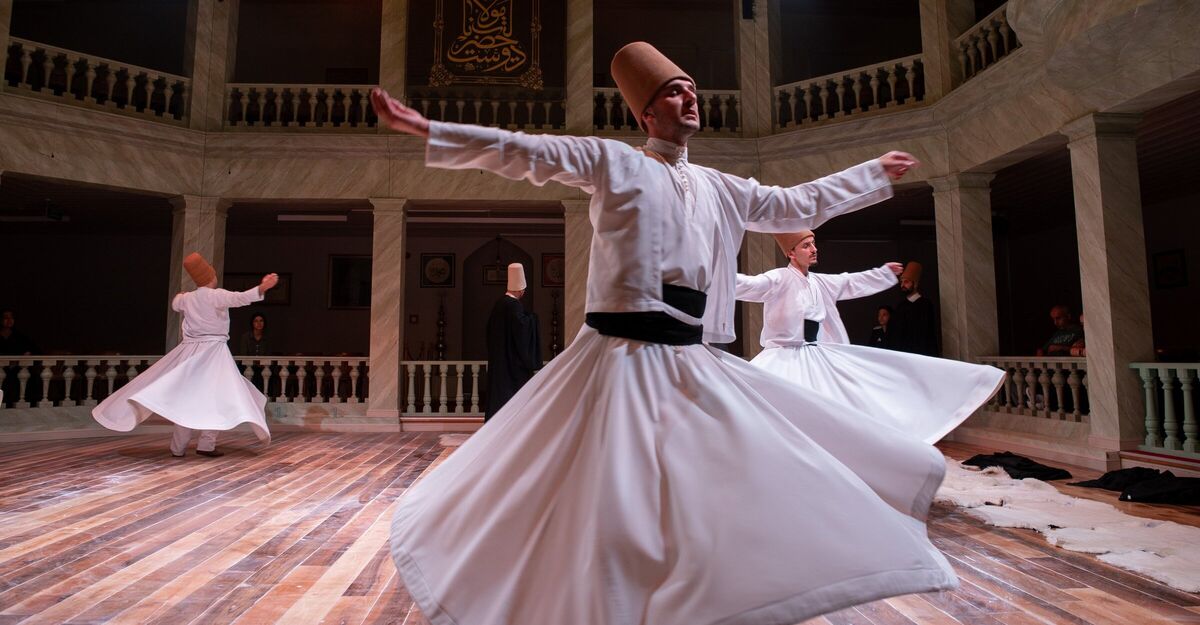
A dervish is a member of a Sufi order, a follower of the mystical path in Islam. The whirling dervishes belong to one order, the Mevlevi, founded in Konya after the death of the poet Jalal al-Din Rumi in 1273. Their ritual is the Sema, a Turkish word from the Arabic samāʿ, "listening". The turning is the part everyone knows, but the Sema begins with listening: to a hymn, to the reed flute, to silence.
Nothing in it is decoration. The clothes, the gestures, the direction of the turn and the order of the music each carry a meaning the Mevlevi have taught for more than seven centuries. What follows is that teaching, as the lodges give it. Individual dervishes will tell you the meaning deepens with practice.
The turn
The dervish turns counter-clockwise, from right to left, around his own heart. He pivots on the left foot and pushes with the right, and the whole circle of dervishes also moves slowly around the hall while each one turns. Mevlevi teaching compares it to everything else in creation that turns: the blood in the body, the planets around the sun, the pilgrims around the Kaaba in Mecca.
The aim is not ecstasy. Watch the faces: they are calm, the eyes half closed, the head tipped a little to one side. The turn is a way of holding one thought, the remembrance of God, with the whole body. In Sufi terms it is a form of dhikr.
The hands
At the start of each turn the dervish's arms are crossed over the chest, hands on the shoulders. Tradition reads this as the shape of the numeral one: a witness that God is one. As he begins to turn, the arms open. The right palm faces up, towards heaven, to receive. The left palm faces down, towards the earth, to pass on what is received. The dervish keeps nothing for himself.
The hat and the robes
Every piece of the dervish's dress stands for death, because the Sema is about the death of the self that stands between a person and God.
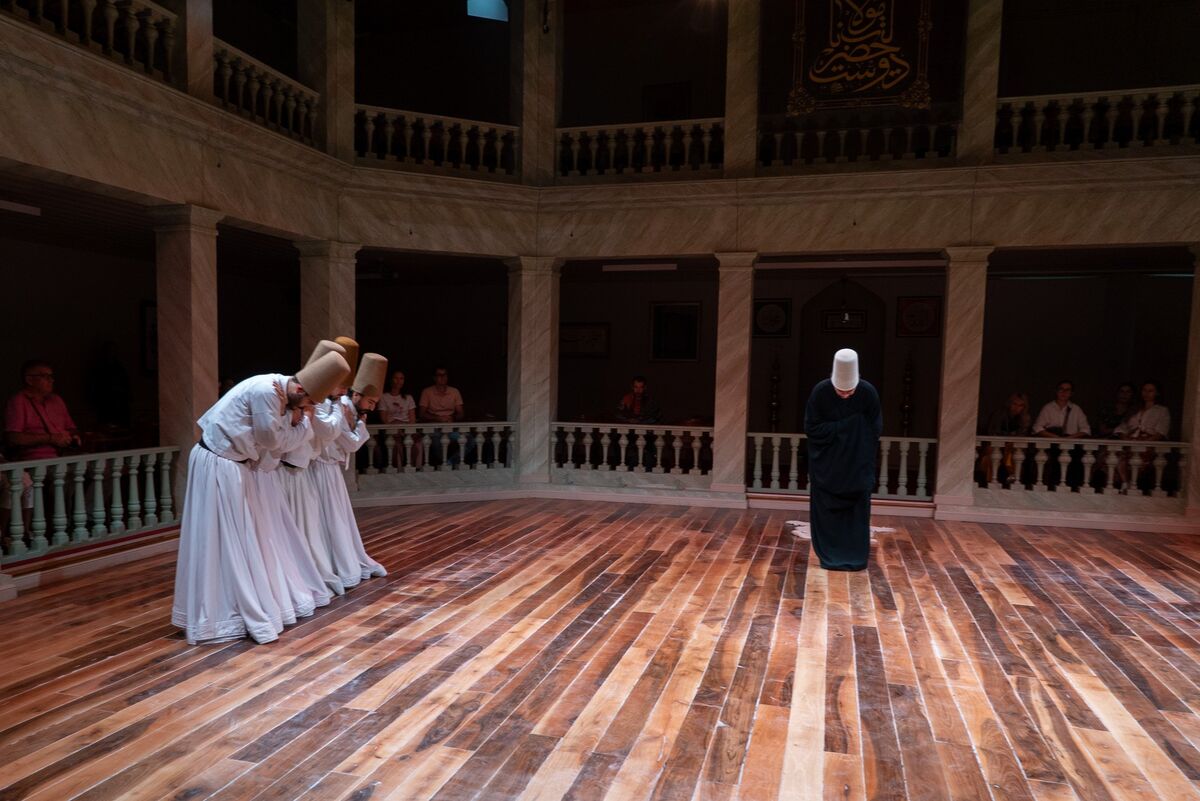
- The sikke, the tall hat of camel-hair felt, is the tombstone of the ego.
- The tennure, the white skirt that opens into a disc as he turns, is the shroud.
- The hırka, the black cloak worn over everything at the start, is the grave. The dervishes let it fall before they turn: they leave the grave behind to be born into the truth.
The full vocabulary of the dress is on the hat and robes page.
The four salutations
The turning comes in four parts, the selams or salutations. Between them the dervishes stop, arms crossed again, and bow. Mevlevi teaching reads the four as stages of a soul's journey:
- The birth of knowledge: a person recognises God as creator and himself as created.
- Wonder: rapture at the order and splendour of creation.
- Love: the wonder turns into love, and the self dissolves in it. This is the stage Sufis call fanā, passing away.
- Return: having completed the journey, the dervish comes back to his place in the world, to live and serve.
The ceremony then closes with a recitation from the Qur'an and a prayer. Nobody applauds. At a working lodge, visitors sit through the last minutes in the same silence as the dervishes.
The music
The Sema is performed to live music, and each instrument has its meaning too. The ney, the reed flute, is the voice of the soul. Rumi opens his great poem, the Masnavi, with it: "Listen to the reed how it tells a tale, complaining of separations", in Nicholson's 1926 translation. Cut from the reed bed, the ney longs to return, as the soul longs for its source. The strike of the kudüm, the pair of small kettle drums, is often explained as the divine command "Be!" that began creation.
The sheikh and the red post
The sheikh leads the rite rather than performing it. His place is a red sheepskin called the post, which marks him as Rumi's representative in the hall. The dervishes bow towards it as they pass. Its red is traditionally linked to the sunset on the evening Rumi died, 17 December 1273, a night the Mevlevi call Şeb-i Arus, the wedding night.
Rite or show?
The meaning above is what you are watching at a working Mevlevi lodge such as Kasımpaşa Mevlevihanesi in Istanbul, where the Sema is held as worship and visitors are admitted. Many evenings sold to tourists in the city are staged versions of it. They are often well done, but the difference matters to some people. There is a full comparison on show vs ceremony.
Questions people ask
- What does the whirling dervish symbolise?
- The turn is a form of remembrance of God. By Mevlevi tradition, the dervish turns like everything in creation turns, receives with the right hand raised and passes on with the left hand lowered, and in doing so empties himself of the ego.
- Why do dervishes raise one hand and lower the other?
- The right palm faces up to receive from God and the left palm faces down to pass it to the world. The dervish keeps nothing for himself; he is the channel between the two.
- Which direction do whirling dervishes turn?
- Counter-clockwise, from right to left, turning around the heart and pivoting on the left foot.
- What are the four salutations?
- The ceremony's four selams, or salutations, are four separate turns. Mevlevi teaching reads them as stages of the soul: recognising God as creator, wonder at creation, the dissolving of the self in love, and the return to the world to serve.
- Is the whirling dervish ceremony a performance?
- At a working lodge it is worship, a form of dhikr, the remembrance of God. Visitors are admitted to watch in silence. Staged versions in theatres and restaurants copy its form.