From Rumi to a Beyoğlu lodge: the history of the whirling dervishes
The whirling dervishes are the Mevlevi, a Sufi order founded in Konya after the death of the poet Rumi in 1273 and organised by his son Sultan Walad. The order spread across the Ottoman Empire, with its greatest lodges in Istanbul, until Turkey closed every dervish lodge in 1925. The Sema returned in public in Konya in the early 1950s, was recognised by UNESCO in 2005 and 2008, and is held again today in rebuilt lodges such as Kasımpaşa Mevlevihanesi, reopened in 2024.
Checked against its sources on .
Rumi
Jalal al-Din Rumi was born around 1207 in Balkh, in present-day Afghanistan, and came with his family to Konya, capital of the Seljuk sultans of Anatolia. He was a respected scholar until, in 1244, he met the wandering mystic Shams of Tabriz, a meeting that turned him into the poet the world knows. His great work, the Masnavi, runs to some 25,000 couplets and opens with the lament of a reed flute cut from its reed bed. Rumi died in Konya on 17 December 1273. Turks call him Mevlânâ, "our master".
The Mevlevi order
It was Rumi's son, Sultan Walad, and the Çelebis who succeeded him who shaped Rumi's circle into an order, the Mevleviyye, with its own rule, music and the ceremony of turning, the Sema. The order grew with the Ottoman state, and its lodges, the mevlevihanes, became centres of music, poetry and calligraphy as well as prayer. Several sultans were devotees; Selim III composed music for the Mevlevi rite.
The Istanbul lodges
Istanbul had five great Mevlevi lodges. Galata came first, in 1491. Yenikapı followed, and then, between 1623 and 1631, Kasımpaşa, founded by Sırrı Abdi Dede, a dervish of Galata, on land he owned above the Golden Horn. The others were Beşiktaş, later moved to Bahariye on the Golden Horn, and Üsküdar. The lodges were rebuilt again and again after fires, often with imperial money: Kasımpaşa by Selim III's mother, Mihrişah Valide Sultan, in 1796, and again under Mahmud II in 1834–35.

1925: the closure
On 30 November 1925 the young Turkish Republic passed Law No. 677, closing every dervish lodge and Sufi order in the country and banning their rites and titles. The lodges were confiscated and put to other uses: Kasımpaşa's ceremony hall went to a wrestling club, which held a New Year's ball in it, and part of the building became a school. The Mevlevi did not disappear. Musicians and dervishes kept the music and the turning alive in private.
The return
In the early 1950s the authorities in Konya allowed the Sema to be performed in public again, in December, to mark Rumi's anniversary, as a cultural rather than a religious event. The commemoration grew into today's International Mevlana Commemoration Ceremonies, held every December in Konya. In 2005 UNESCO proclaimed the Mevlevi Sema Ceremony a Masterpiece of the Oral and Intangible Heritage of Humanity, and in 2008 inscribed it on the Representative List of the Intangible Cultural Heritage of Humanity.
The lodges today
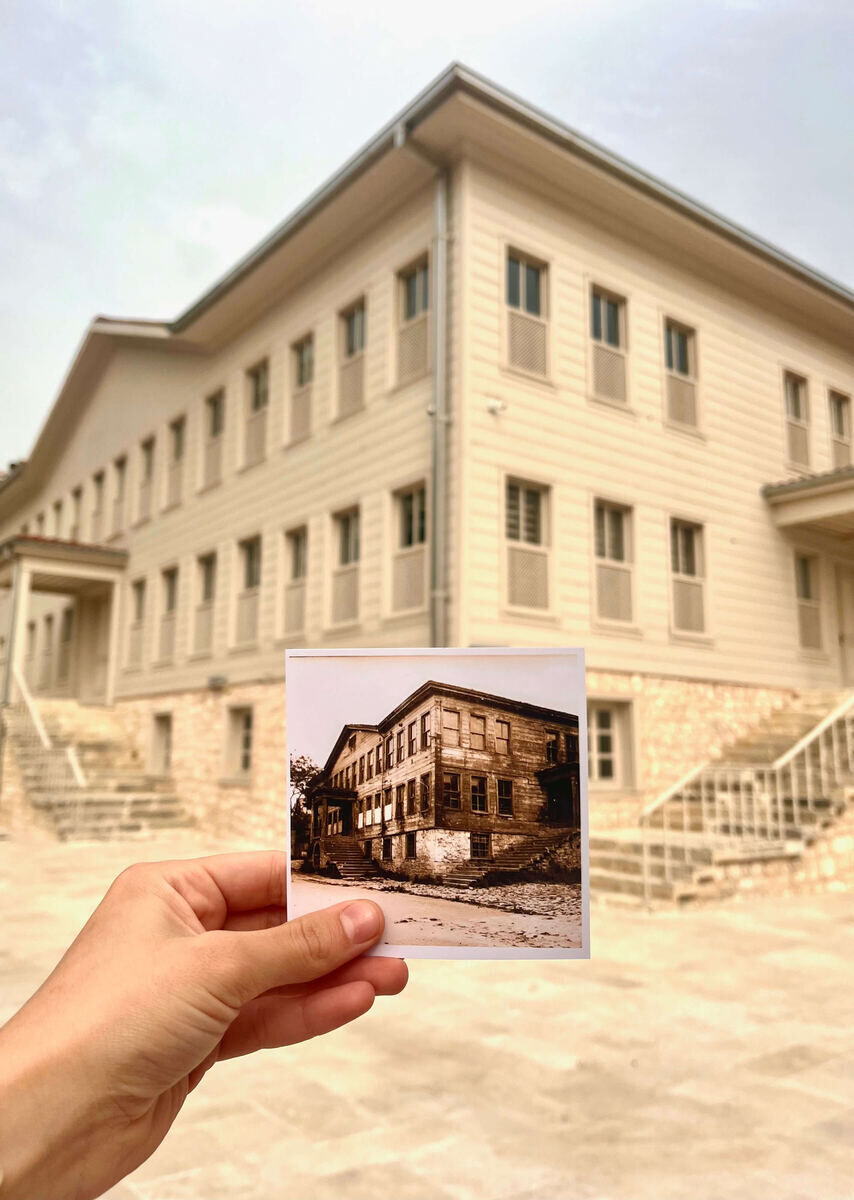
Galata became a museum. Kasımpaşa fared worse: in the spring of 1979 a fire destroyed the wooden lodge, leaving only its stone stairs, its gate and a small graveyard. The General Directorate of Foundations rebuilt it in its original form on its original plot, and on 11 May 2024, 99 years after the closure, it reopened, run by the İnsan ve İrfan Foundation. A poem over the new entrance encodes the year of reopening in the old way, as a chronogram: read as numbers, its letters give 1445 in the Hijri calendar. The first Sema in the rebuilt hall was held on 18 May 2024, and the ceremony now takes place there three times a week.
The full timeline of the lodge is on the Kasımpaşa Mevlevihanesi page.
Questions people ask
- Where did the whirling dervishes originate?
- In Konya, in present-day Turkey, among the followers of the poet Jalal al-Din Rumi (1207–1273). The Mevlevi order was organised after his death by his son Sultan Walad.
- Do whirling dervishes still exist?
- Yes. The Mevlevi lodges were closed in 1925, but the tradition was kept alive, the Sema returned to public view in the 1950s, and today it is held in Konya, in Istanbul lodges such as Kasımpaşa Mevlevihanesi, and around the world.
- Why were the whirling dervishes banned in Turkey?
- Law No. 677 of 30 November 1925, part of the early Republic's reforms, closed every dervish lodge and Sufi order in Turkey and banned their rites. The Sema was later permitted as a cultural performance.
- When did UNESCO recognise the whirling dervish ceremony?
- UNESCO proclaimed the Mevlevi Sema Ceremony a Masterpiece of the Oral and Intangible Heritage of Humanity in 2005 and inscribed it on the Representative List of the Intangible Cultural Heritage of Humanity in 2008.